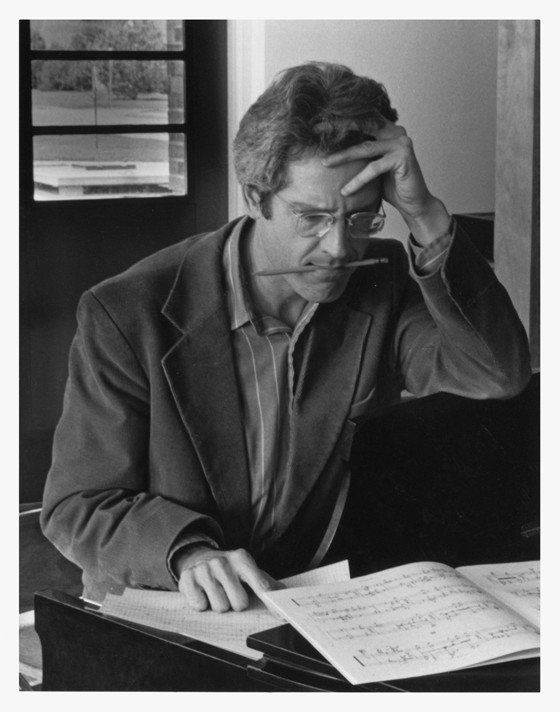
Peter McKenzie Armstrong (born March 12, 1940) is an American composer and pianist. His forty-some works have drawn most strongly from sources not primarily associated with music -- integer sequences, Markov chains, axial rotation, tessellation structures, chemical element properties, Archimedes' Ostomachion, the Periodic Table, et al -- with the goal to convey their shapes and proportions persuasively in sound. Most of his works are scored in LilyPond for piano, either solo or in mixed duo. Other works include several for flute and earlier pieces for MIDI ensembles and Csound.
Generation Most of Armstrong's works are developed algorithmically (in APL/J), then scored in LilyPond. Extensive composer-edits to LilyPond's secondary MIDI output produce final demonstration audio. For solo piano works, this WAV result is then converted to MP3 and input to Pianoteq for realization on one of its "Bösendorfer" instruments.
Access
Scores, published by Edition Ottaviano Petrucci, may be accessed and downloaded at the International Music Score Library Project (IMSLP). The audio is similarly available at SoundCloud, and video (score page-turn-synced with audio) is online at YouTube and the Internet Archive. Armstrong's personal website is at Eskimo.com.
Compositions
Discovered by Karl Straub in 1917, an 18C copyist's manuscript titled Partita Solo pour la Flûte Traversière appears to be Sebastian Bach's solitary work for unaccompanied flute. Composed circa 1720, its movements represent with one exception the standard core of the Baroque solo suite. Its prescribed instrument was not the end-blown default of that day (a recorder), but the cross-blown then recently evolved from the fife of military use.
I have set about to refashion Bach's Partita by reinterpreting "traversiere" as a reference, not to the perpendicular breath flow unique to this instrument, but to the composition process per se. With the word correspondingly repositioned in this work's title, four movements pursue the idea as follows:
Expansion. The Allemande's beat-beamed quadruplets, each taken as intervallically fixed, were externally reordered via ascending sort of their pitch spans. Each was then transposed to set one extreme pitch at E5 (a 10th above Middle C) with the group fanning upward or downward according to the melodic direction of its 2nd-4th members. The resulting sequence radiates in alternating direction from focal point to outer limit -- by chance, from the Allemande's initial to final tones.
Star Finder. Corrente measures 2-3 were input to an algorithm of mine that, given the X/Y dot-graph coordinates for a metered pitch sequence, rotates its pattern through half-circle, tracking the attack-order swaps thereby forced and upward-grading each impacted attack-time vector. Given this backward start without further intervention, the process evolved towards and ended with JSB's original opening, as though "bound and determined" to get it right. The movement is named after Prof. Whitney's little astronomical device, whose traversal so well models the algorithm.
[Unaccompaniment]. Hearing JSB's Sarabande, I wish occasionally for more harmonic definition. As the wish remains frustrated I offer in revenge this alternative, a "continuo without melody". It is textured in fact as two melodies (one to be pre-taped), and maximizes periodicity of harmony and phrasing. The result is best heard as accompanying the listener's silent(!) memory of the Sarabande itself, which it almost fits.
Collapse. Each of the Bouree's beat-beamed note groups was taken to represent that group's mean pitch (reckoned as the sum of pitches divided by the number of notes). First sorted by metrical type, the groups were then reoriented to the focal E of movement 1 through a further nested sort: by mean pitch as higher or lower than the focus; by shrinking mean-to-focus interval. Thus this work's initial metaphor, radiation, was reversed. The music now instead backs into its point of origin -- in a spiralling, sputtering image less of doom than of laughter.
The piece is intended for performance immediately following its antecedent.
Duration: [6:11]
This work won call-for-scores award performances at CCI, CMS and ARTSPACE (New Haven).
This work was inspired by John Elliot's mural, painted outdoors at Burd Street, Nyack, NY in 1984. As only ever winner of the Friends of the Nyacks arts competition, it can be viewed online at the Hudson River Valley Heritage site. Documentation on Elliot's work overall - paintings, films, published writings - is similarly accessible at JohnElliot.com.
The music, four movements for piano solo, reflect on his painting's leading motifs.
Mountain Meets River With middle-D as the shoreline, broken chords in the treble ring over linear flow in the bass, their harmonies in alternation. Subsections, each with its second half inverted (as the Hudson's reflection), yield self-opposing modal pairs, their member chords sequenced for increasing cragginess in succession.
Steamboat (Chugs & Flaps) This conjures the engines of two riverboats close-passing in opposite directions. Their shared two-bar "Chugs" repeat perpetually but with unequal interim pauses, yielding phase shift such that the motifs re-juxtapose always differently. Two series nudge them -- the first into, the second out of, sync. "Flaps" (a "JE" pennant and a vintage 1848 Old Glory) buffet meanwhile in opposing modes.
Sunbursts Each bar consists of an up-to-12-note downward-rolled chord. Each chord contains two intervals, alternating until just short of pitch-class redundancy. No two interval parings are the same. The V-shaped bass-pitch succession is meant to convey the mural's pattern of sunbeams as they strike the river surface.
Man in Skiff In this final movement I take the painting's singular human figure to represent Elliot himself - the surviving grandson of Tsar Nicholas II, navigating as he can with whiffs of Mussorgsky in the back of his mind. I've rendered its melody as closely as possible to the videotape he, a virtuoso mandolinist, made from hospital bed shortly before his death.
Duration: [5:28]
ORGANIZATION
The Periodic Table lists in atomic-number order the 118 known elements, grouping them according to the pattern of recurrence in their properties (termed "trends"). I have fashioned these as movements, building each from its pattern of member atomic numbers.1. Enthalpy-V 6. Enthalpy-F 11. Elec-Affin
2. Melting-Pt 7. Boiling-Pt 12. Ioniz-Poten
3. Density 8. Orbitals 13. A-Weight
4. Electroneg 9. Oxi-State Min 14. Oxi-State Gaps
5. A-Radius 10. I-Radius 15. Isotopes
COMPOSITION
Generation: Each data series was scaled and rounded, first to index 6 octaves of keyboard pitch, separately to index 16 levels of duration. The elements of each resulting monophonic series were then cardinally/ordinally swapped, yielding an opposite series embracing simultaneity.Section pairing: In the final score, some but not all of the value/index-swapped sections directly abutt their monophonic counterparts. I have repositioned some for better pattern contrast.
PERFORMANCE
Rhythm: The elapsed time between successive note-beginnings is proportional to the horizontal space between successive noteheads. The individual note's sounding duration is instead flexibly proportional to its notehead size.Articulation: Notes are to be separated by articulative silence *unless* a slur connects them. Within a slur legato applies up to, but not beyond, its final note. Other marks (spiccato, tenuto) are meant to nuance, not contradict, the above. Diagonal lines between staves are meant to extend slurs across the system.
Pedaling: Where, as often, the hand cannot manage legato connection, slurs are to be interpreted as pedal indications. The pedal is to be used only in this way - not also to connect between slurs.
Dynamics: Volume is generally to parallel duration, that is, notehead size, unless qualified by accent.
Superclusters: As I have chosen to include all pitches inititially generated, the lower (swapped-parameter) sections contain chords of up to 29 pitches! The player is humbly invited to edit (roll/break/trim/carve) these at his/her discretion.
Duration: [12:39]
J.S. Bach's Das Wohltemperierte Klavier, Op.39 (2025)
GENERATION
Encoded as an X/Y dot graph, rotated 90 degrees, then read in that position left-to-right, musical scoring is seen with its essential parameters exchanged, pitch indications having become instead relative attack times and vice versa. With the rotation anticlockwise (as in these examples), pitchwise top/bottom translate to timewise first/last, etc.I have applied this procedure to the Fugue subjects of J.S. Bach's Das Wohltemperierte Klavier, trusting that juxtaposition of such originals (linear only) and their rotations (mainly chordal) may enhance its promise as a compositional option.
As used here, the rotation addresses its source's sounding notes only (not also rests) and without subsequent reportioning of the results (as with many integral‐serialist algorithms). For a representative generating graph see Appendix A. For an example addressing also the reverse rotation (simultaneity->linear recurrence) see App. B. Articulations for performance of the source subjects themselves are suggested in App. C.
RE "X/Y‐>Y/X" SECTIONS:
NOTATION
– Notehead colors: green, the original's recurrent pitches; red, the rotation's corresponding simultaneities; grey, exceptions (applying in both senses).
– Accidentals (default '#' in their generating graph) are respelled in their score as appears harmonically and voice‐leading‐wise most plausible.
– Meter signatures and articulation markings are chosen post‐process as best to convey emergent patterns.
PERFORMANCE
– Accidentals apply once only, c/o LilyPond's style "forget".
– Tied anticipations, unless slashed, are to occur on‐beat.
– Legato connection is intended only within slurs, not also from their final note.
– Damper pedal use is expected for realizing slurs where necessary, or for enhancing immediate resonance, but not for connecting non‐slurred notes.
– I suggest programming as a selection of perhaps six of these pages with their order, tempi, dynamics and hand distributions at player's discretion.
Duration: 5-15 minutes